Owe More Than Your House Is Worth in PA? Short Sale vs. Other Options
Short answer: if you owe more on your house than it would sell for, you still have options in Pennsylvania. You can keep the house and wait, ask your lender about a loan modification or repayment plan, sell and bring the difference to closing, or ask the lender to approve a short sale, where it accepts less than the full payoff. Each path has real trade-offs, including possible taxes on forgiven debt, credit impact, and whether the lender can still pursue the leftover balance. The first step for most homeowners in Luzerne and Lackawanna County is getting an accurate payoff number and talking to a HUD-approved housing counselor before anything else.
Below, each option in plain English, for homeowners in Scranton, Wilkes-Barre, and the rest of Northeastern PA.
First, find out if you are really underwater
Many homeowners guess at this, and the guess is often wrong. You need two figures:
- What you actually owe. Ask your mortgage servicer for a written payoff statement. It is usually higher than the balance on your monthly statement because it includes interest through the payoff date and any fees, and if you are behind, late charges and other costs. Add any second mortgage, home equity line, and any liens such as unpaid taxes, sewer or trash bills, or judgments.
- What the house would realistically sell for. Online estimates can be far off for older NEPA homes, especially houses that need work. Recent nearby sales, a local agent's opinion, or an appraisal will tell you more.
Then subtract selling costs. In Pennsylvania that typically includes realty transfer tax and, if you list, an agent's commission. Our guide to closing costs when selling a house in Pennsylvania breaks those down. If the sale price minus costs is less than everything you owe, you are underwater. If it is close, you may have more room than you think.
Option 1: Keep the house and wait
If you can afford the payments and do not need to move, waiting can be reasonable. Every payment reduces the principal, and values change over time. It works poorly when payments are already a struggle, because falling behind adds fees and interest that widen the gap.
Option 2: Talk to your lender about a workout
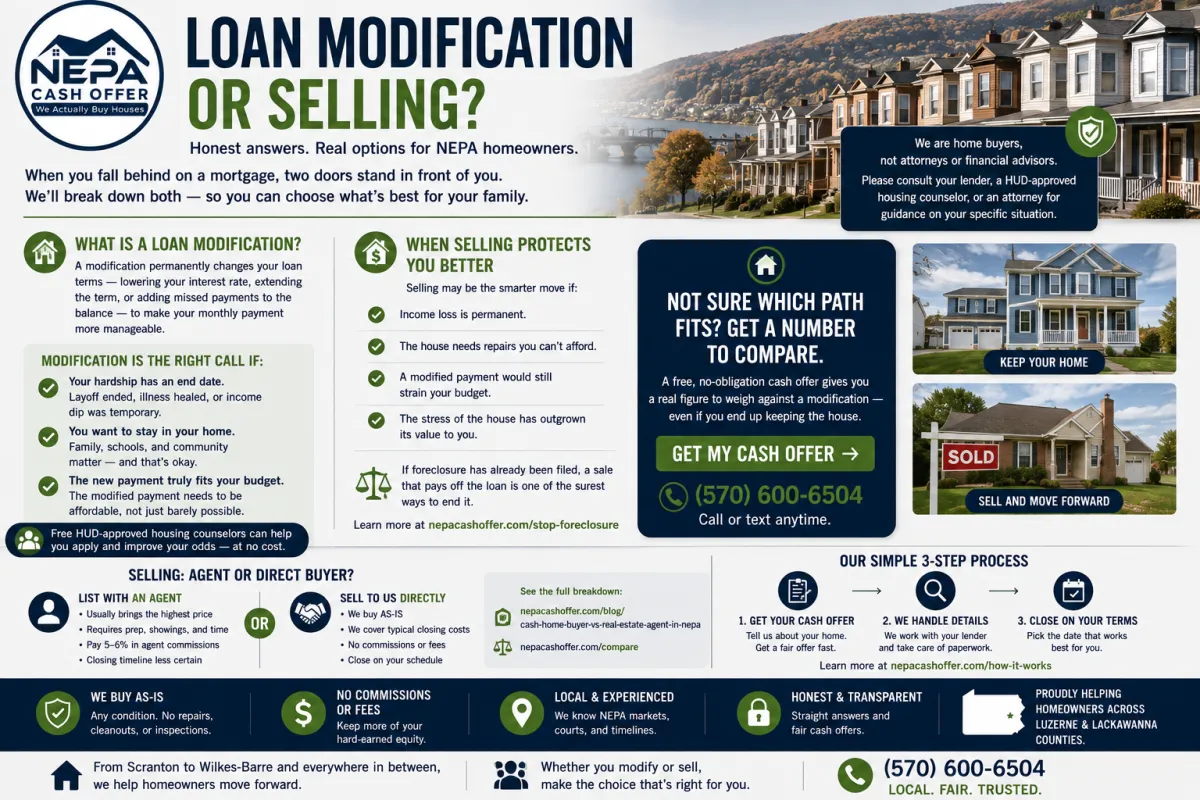
If the problem is the monthly payment rather than the value, a lender may offer a loan modification, a repayment plan, or a forbearance. These are designed to help you keep the house. We compare them with selling in our article on loan modification vs. selling your NEPA home.
Pennsylvania homeowners who are behind may also qualify for help through the Pennsylvania Housing Finance Agency, which runs the state's Homeowners' Emergency Mortgage Assistance Program (HEMAP). Eligibility rules apply, so check with PHFA or a housing counselor. You can find a HUD-approved housing counselor through HUD's website or the Consumer Financial Protection Bureau's counselor search, linked at the bottom of this page. If you have already received foreclosure notices, read our guide to pre-foreclosure in Pennsylvania and our foreclosure help page for local resources.
Option 3: Sell and bring cash to closing
If the shortfall is manageable and you have savings, you can sell the house the normal way and pay the difference at closing. The title company pays off the lender in full, the lien is released, and there is no short sale approval, no forgiven debt, and no 1099-C. For some sellers, especially when the gap is small, that is the simplest way out. Our article on selling a house before paying off the mortgage in PA explains how payoffs work at closing.
Option 4: Ask the lender to approve a short sale
In a short sale, the lender agrees to accept less than the full payoff so the house can sell. Lenders generally look for a genuine hardship, such as a job loss, divorce, medical issue, death in the family, or a required move, combined with a home that is worth less than the debt. A typical short sale goes something like this:
- You contact the servicer's loss mitigation department and ask for its short sale application package.
- You submit financial documents, usually a hardship letter, pay stubs or proof of income, bank statements, and tax returns.
- You get a buyer's written offer. The lender reviews the offer, typically orders its own valuation of the house, and decides whether to accept, counter, or decline.
- Every lienholder has to sign off. If there is a second mortgage or home equity line, that lender has to agree too, and it may ask for a payment to release its lien.
- You get an approval letter with conditions and a closing deadline.
Short sales take patience. The lender's review often takes weeks or months, and the buyer has to be willing to wait. Before you sign, look closely at three things: whether the approval waives the remaining balance (the deficiency), whether forgiven debt will be reported on IRS Form 1099-C as income, and how the sale will affect your credit. The FAQ below covers each one, and an attorney and tax professional should review the actual paperwork.
Option 5: Deed in lieu of foreclosure
Some lenders will accept a deed in lieu, where you sign the house over to the lender instead of going through foreclosure. Lenders often want to see that the house could not be sold first and generally need clear title, so a second mortgage or other liens can get in the way. The same deficiency, tax, and credit questions apply.
What happens if you do nothing
If payments stop and no workout or sale happens, the lender can file a foreclosure action in the county Court of Common Pleas, in Wilkes-Barre for Luzerne County or Scranton for Lackawanna County, and the house can eventually be sold at a sheriff sale. Read every notice your lender sends, because Pennsylvania notices often describe assistance you may qualify for. Our article on what happens at a sheriff sale in Pennsylvania explains that stage. The earlier you act, the more of these options stay open.
Where a cash sale fits
A cash buyer cannot fix negative equity by paying more than the house is worth, and anyone who promises that should make you cautious. Where a cash offer can help is on the cost side. Selling as-is means no repairs, no showings, and no agent commission, so more of the price goes toward the payoff. For houses that need major work, that can sometimes close a small gap. And if a short sale is the route, a written offer from a buyer who can wait out the lender's review is part of what the lender will ask to see.
Here is how it typically works with us: you reach out, we look at the house, and we provide a written, no-obligation offer. You compare it against your payoff statement, talk it over with your counselor or attorney, and decide. Our how it works page walks through each step, and our cash vs. agent comparison lays out both options side by side. If the house came to you through a family estate and the mortgage is more than it is worth, our inherited homes page covers questions heirs often ask.
We work with homeowners across Luzerne County and Lackawanna County.
Frequently asked questions
What is a short sale in Pennsylvania?
A short sale is a sale where the mortgage lender agrees to accept less than the full payoff so the house can be sold and the lien released. The lender has to approve the buyer, the price, and the closing figures, and every lienholder (for example, a second mortgage) usually has to agree as well. It is a negotiation with the lender, not something the seller or buyer can decide alone.
Can a lender still come after me for the difference after a short sale?
It depends on the agreement. Some short sale approvals waive the remaining balance (the deficiency) and some do not, or they ask for a cash contribution or a promissory note. Read the approval letter carefully, and have a Pennsylvania real estate or consumer attorney review it before you sign anything, because the wording matters.
Is forgiven mortgage debt taxable?
It can be. When a lender forgives debt, it may send IRS Form 1099-C, and canceled debt is generally treated as income unless an exclusion applies. Whether an exclusion (such as insolvency) applies to you depends on current tax law and your finances, so talk to a tax professional before you agree to a short sale.
Does a short sale stay on my credit?
A short sale is generally reported to the credit bureaus and usually lowers your score, though how much varies from person to person, and missed payments before it are reported too. A HUD-approved housing counselor can explain what to expect in your situation.
Can I sell my house for cash if I owe more than it is worth?
Possibly. A cash buyer cannot pay more than the house is worth, so if the offer does not cover your payoff and closing costs, you would need to bring money to closing or get the lender to approve a short sale with that buyer's offer. A written offer can at least give you real numbers to compare against your payoff statement and your other options.
The bottom line
Owing more than your house is worth is stressful, but it is a math problem with several possible answers, not a dead end. Get a written payoff statement, get a realistic value, and talk to a HUD-approved housing counselor and, if needed, an attorney or tax professional before you choose. When you are ready to see real numbers, visit the NEPA Cash Offer homepage, request a cash offer, or call (570) 600-6504.


