Selling a House in a Flood Zone in NEPA: What Sellers Need to Know
Short answer: you can sell a house in a flood zone in Northeastern Pennsylvania. What changes is the paperwork and the buyer pool. Pennsylvania requires sellers to disclose known flood risk indicators, buyers with federally backed mortgages in high-risk zones must carry flood insurance, and a house with past or current flood damage usually sells for less. Knowing your FEMA zone, your insurance options and your disclosure duties up front helps you price it right and avoid surprises at closing.
Flood risk is part of life along the Susquehanna, the Lackawanna and the many creeks that run through Luzerne and Lackawanna counties. Families in Kingston, Forty Fort, Plymouth, West Pittston and Wilkes-Barre remember the big floods. If you are thinking about selling a home in or near a floodplain, here is what matters.
Why flood history matters so much in the Wyoming Valley
According to the U.S. Army Corps of Engineers, the Wyoming Valley levee project on the Susquehanna dates to 1936 and reduces river flood risk for Plymouth, Kingston-Edwardsville, Swoyersville-Forty Fort, Hanover, Exeter and Wilkes-Barre. Hurricane Agnes overtopped it in 1972. The levees were raised 3 to 5 feet in a project finished in the 2000s, and in September 2011 Tropical Storm Lee pushed the river to a crest of 42.66 feet, higher than Agnes, without overtopping the system. Areas outside the levee system, and homes near smaller streams, do not have that protection.
The result: plenty of NEPA houses sit in or near mapped flood areas, some have flood claims in their history, and many owners in the levee area also pay a levee fee. Buyers, lenders and insurers all look at this, so it is better to know your facts first.
Step 1: Find your flood zone
Type your address into FEMA's Flood Map Service Center. It shows the effective flood map for your street. FEMA explains that Zone A areas have a 1% annual chance of flooding, which works out to a 26% chance over a 30-year mortgage. Zones that start with A (and V on the coast) are Special Flood Hazard Areas. FEMA also has a Zone A99 for areas that will be protected by a federal flood control system where construction has reached specified legal requirements. Moderate- and low-risk zones (often labeled B, C or X) can still flood; they just do not trigger the federal insurance mandate.
Print or save the FIRMette (the map snippet) for your file. Buyers and their agents will look it up anyway, and having it ready shows you are being upfront.
Step 2: Know what you have to disclose
Under Pennsylvania's Real Estate Seller Disclosure Law (68 Pa.C.S. Chapter 73), a seller must disclose known material defects on a property disclosure statement and give the signed form to the buyer before the sales agreement is signed. The form must cover land issues, including soils, drainage, sinkholes and flood risk indicators, plus the location and condition of any storm water facilities.
The definitions in Chapter 71 spell out what counts as a flood risk indicator:
- whether the property has had flood damage before, and how many times and roughly when,
- whether it is in a FEMA special or moderate flood hazard area,
- whether the owner is required to carry flood insurance,
- whether the seller received any government assistance for flood damage, and
- whether the seller ever filed a flood insurance claim, private or through the National Flood Insurance Program.
The law also changed recently. Act 74 of 2026 (House Bill 1704) added a required written flood insurance notice that sellers will give buyers once the Pennsylvania Insurance Department posts its flood information online, and the Insurance Department says the amended disclosure form itself will not be required until July 2028. The law does not require you to investigate things you do not know, but you cannot hide what you do know. If the house had water in the basement after Lee, say so.
One wrinkle: the law exempts some transfers, including certain sales by a fiduciary administering a decedent's estate. If you are selling an inherited house as executor, ask the estate attorney what disclosures you owe. Being honest with buyers is still the safest course.
Step 3: Sort out flood insurance before you list
FEMA notes that Congress requires federally regulated or insured lenders to require flood insurance on buildings in a Special Flood Hazard Area that secure a federally backed loan. That means most buyers using a mortgage on a high-risk house will have a flood premium added to their monthly payment, which can shrink what they can afford to offer.
Two things can help:
- Assign your policy. If you carry a National Flood Insurance Program policy with building coverage, FEMA allows it to be assigned to the buyer when title transfers. Per the NFIP Flood Insurance Manual, the seller signs the assignment on or before the closing date and the buyer has up to 30 days after closing to submit it. Contents-only policies cannot be assigned. A buyer may also be able to keep any discounted premium you had.
- Get a quote early. Ask an insurance agent to quote the house for a new buyer so you and your buyer know the real number instead of guessing.
Step 4: Decide how to handle flood damage
If the house has flooded, the condition now matters more than the map. Mold, warped floors, a soaked furnace or a cracked foundation scare off many retail buyers and can stop a mortgage appraisal. You have three basic paths:
Repair, then list
This can bring a higher price if the repairs are done right, with permits and receipts. It also takes cash, time and contractors. Our guide on hiring a contractor in NEPA helps if you go this route, and selling a house with water damage or mold covers mold specifics.
List as-is with an agent
You skip the repairs but may wait longer, field low offers, and see deals fall apart over inspections or financing. See what selling as-is really means.
Sell as-is for cash
A cash buyer has no lender, so there is no lender-required flood insurance or appraisal hurdle. The trade-off is price: cash offers on damaged houses are usually lower than what a fixed-up house would bring. Compare the numbers with our cash vs. agent comparison and cash offer vs. listing: the real net.
Quick guide by situation
| Your situation | What it usually means for a sale | Good first step |
|---|---|---|
| In a high-risk zone (A zone), never flooded | Buyers using a federally backed loan will need flood insurance; that cost affects what they can pay | Get a flood insurance quote and pull your FEMA map before you price the house |
| Has an NFIP policy now | The policy can often be assigned to the buyer at closing | Ask your agent for the policy details and assignment form |
| Flooded before, repaired | Past flood damage and claims are disclosure items; good records help buyers trust the repairs | Gather claim paperwork, contractor invoices and permits |
| Flooded, damage still there | Most retail buyers and lenders will balk; an as-is sale is often the realistic path | Get a repair estimate and an as-is cash offer, then compare |
| Inherited house in the floodplain | Estate carries insurance and upkeep while it is open; disclosure rules can differ for executors | Talk to the estate attorney before listing or signing |
Other issues that travel with flood-zone houses
- Foundation and settling. Repeated water can undermine foundations. See selling a house with foundation problems, and if you are in coal country, mine subsidence risk.
- Vacant after a flood. An empty, damaged house costs money every month and can draw code letters. See selling a vacant house in NEPA and selling with code violations.
- Older homes. Many river-town houses are a century old with stone basements that take on water. Our guide to selling an older Wilkes-Barre home and Kingston seller's guide go deeper.
How a sale like this works with us
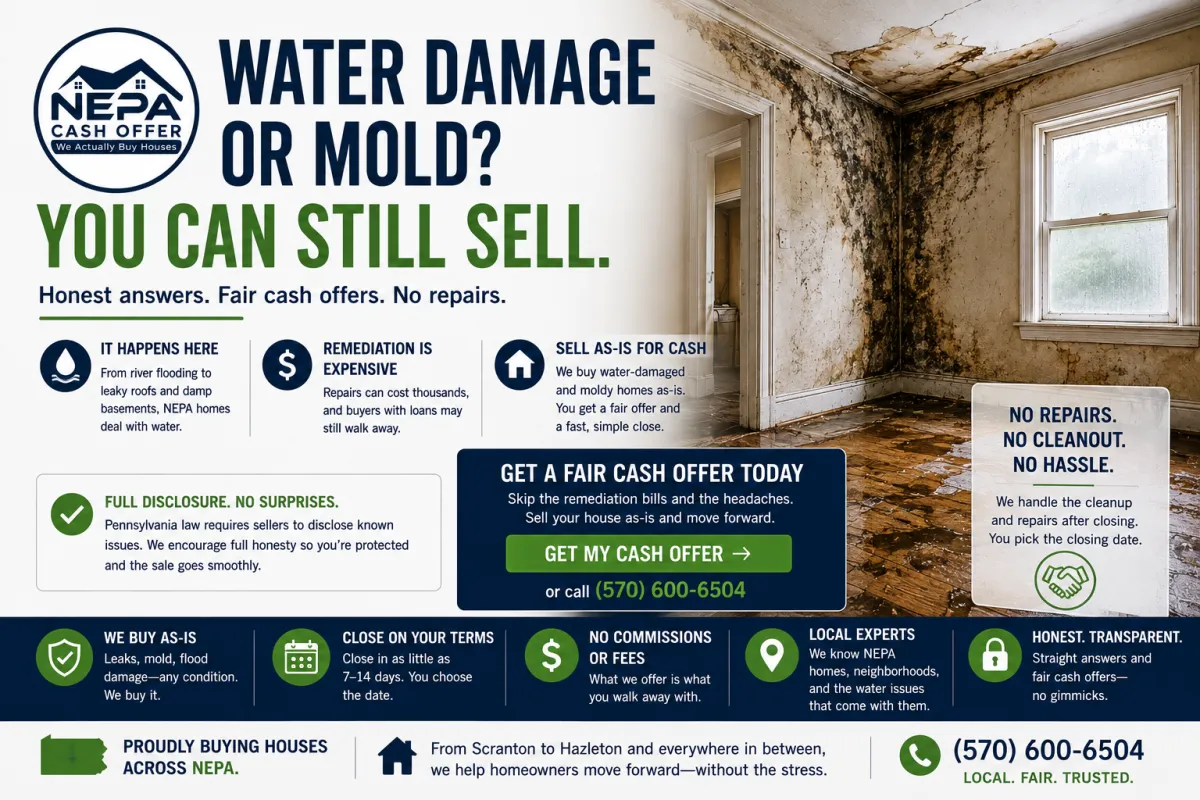
We look at the house, including the basement and any flood repairs, and give you a written, no-obligation offer for it as-is. You do not need to fix the damage, clean out the basement, or buy flood insurance for us. A local title company handles the closing, and you pick a closing date that works for you, usually in as little as 14 days or later if you need more time. If repairing or listing would likely net you more, we will say so. Our how it works page explains the steps, and how to spot a legitimate cash buyer helps you vet anyone you talk to. We also buy in Scranton and across NEPA.
Frequently asked questions
Do I have to tell a buyer my house is in a flood zone in Pennsylvania?
Pennsylvania's Real Estate Seller Disclosure Law requires sellers to disclose known material defects on a property disclosure statement, and the form must cover land issues including drainage and flood risk indicators. State law lists flood risk indicators such as past flood damage, whether the property is in a FEMA special or moderate flood hazard area, whether flood insurance is required, flood-related government assistance, and past flood insurance claims. Some transfers, such as certain sales by an estate's executor, are exempt, so ask a real estate attorney about your situation.
How do I find out if my NEPA house is in a flood zone?
Enter the address at FEMA's Flood Map Service Center (msc.fema.gov). It shows the effective flood map and the zone for that spot. Zones that start with A are high-risk areas that FEMA calls Special Flood Hazard Areas.
Can a buyer take over my flood insurance policy?
Often, yes. FEMA allows a National Flood Insurance Program policy with building coverage to be assigned to the buyer when title transfers. The seller signs the assignment on or before closing, and the buyer has up to 30 days after closing to submit it to the insurer. Contents-only policies cannot be assigned. Your insurance agent handles the paperwork.
Will a buyer's lender require flood insurance?
If the house is in a Special Flood Hazard Area and the buyer's loan comes from a federally regulated or insured lender, federal law requires flood insurance on the building. A cash buyer has no lender, so there is no lender requirement, though the buyer may still choose to carry it.
Can I sell a house that has flooded before without fixing it?
Yes. You can sell as-is to a buyer who accepts the condition, whether that is an investor or a cash buyer. You still need to disclose what you know, and you will usually get a lower price than a fully repaired house would bring on the open market.
The bottom line
A flood zone does not make a NEPA house unsellable. Pull your FEMA map, gather your insurance and repair records, fill out the disclosure honestly, and get real numbers for each path before you decide. When you want a no-pressure cash number, visit the NEPA Cash Offer homepage, request a cash offer, or call (570) 600-6504.


